[Photo courtesy of The New Yorker]
By Venus Rittenberg, Editorial Director
I went home last weekend and saw one of the best movies I had ever seen. For those who missed it, A24 re-released the 1984 concert documentary about the best new wave/post punk band of all time, Talking Heads. Stop Making Sense, the film named after the band’s album, is as good as it gets for many. It is many people’s favorite concert documentary, and many people’s favorite Talking Heads album. And honestly, who could blame them? It is not my favorite Talking Heads album (it isn’t even my favorite Talking Heads live album, I think the deluxe reissue of 1982’s The Name of This Band Is Talking Heads is better, as it essentially functions as a greatest hits of their first four albums), but it is understandable why someone would feel this way. It contains many amazing renditions of some of some of their best songs, including the best songs from their stupendous fifth album, Speaking In Tongues, which is the album they were touring for when they made this movie.
The movie opens with an empty stage. Frontman David Byrne comes out on stage with a boombox and an acoustic guitar and announces that he’d like to play a tape for the audience. Their breakout single, “Psycho Killer”, begins to play. Byrne is strumming his guitar, singing in his incredible voice, and doing his unique little dance moves (we’ll get more into his dancing later). This rendition of the song is unique, but immediately captures a viewer’s attention. The back of the stage is visible, and Byrne is alone.
Bassist Tina Weymouth comes out on stage. The two play the phenomenal “Heaven” from 1979’s Fear of Music (my personal favorite Talking Heads album). The two stand still on stage, close to each other. Even already, adding more instruments to the field adds a whole new realm of depth to Talking Heads’ music. It is clear that a viewer is in for a treat. Drummer Chris Frantz comes out and they play the opener to 1978’s More Songs About Buildings and Food, “Thank You for Sending Me an Angel”, a song that absolutely requires drums. The drums, once again, add a whole new world to the music. The marching beat of the song is intense, and while the song is short, it leaves its mark.
Jerry Harrison comes out. Finally, the whole core lineup is out there, and they play “Found a Job”, also from More Songs. Backup singers come out. The use of backup singers became prominent when the band shifted to a 10-piece for 1980’s Remain In Light, generally considered to be the band’s best and most experimental. It is easy to see why the masses feel this way about the album, it is truly revolutionary, and contains arguably their most popular song, “Once In a Lifetime”, as well as personal favorite, “Born Under Punches (The Heat Goes On)”. The backup singers’ first song on the stage for Stop Making Sense is “Slippery People” from the aforementioned Speaking In Tongues. The backup singers are necessary for this song, they do a call and response with Byrne in the chorus.
Finally, for the sixth song, the entire band is out, and what a wonderful collaboration they make. “Burning Down the House”, their only top 10 song, is explosive. The band is at a peak here. This demonstrates just how special and talented the band is. The song is simply breathtaking. The synths, the lyrics, the drums. All of it is iconic. The music flowing from the stage through the theater speakers is some of the best the listener will ever hear. The band is finally a whole, and they function fantastically as a group. The synergy is palpable, and flows for the rest of the film. This is one of the best bands of all time. If it wasn’t definitive already, it is made definitive by this performance.
However, “Burning Down the House” is not the best performance here. That would be the followup, “Life During Wartime”. “Life During Wartime” is already one of the band’s best songs, but it is made perfect by the hilarious and profound dancing Byrne does throughout this performance. It’s kind of incredible the way he can move. He does wiggly things with his arms and legs, but with such synchronicity that it plays out very well. He does laps around the stage, he does all sorts of funny movements. But it all works so well. The music is impeccable too. “Life During Wartime” is a fascinating song, comparing the life of a touring musician to a spy. It has an almost cyberpunk dystopian image of New York, and the music is bombastic. Very catchy, like all the best Talking Heads songs.
One of my favorite songs from Speaking In Tongues is next, “Making Flippy Floppy”. This song is goofy and playful, both musically and lyrically. It is super danceable. Random words (like sandwich and Star Wars) flash on the stage in the background of this song as the music booms through the theater. This is a fun song, and this performance is lively and exciting, perfectly playing with the following song, “Swamp”. “Swamp” features Byrne singing in an unusual voice, and a chorus that sees him repeating the noise “hi” 13 times in a melody that makes the song an earworm. It also contains the incredible lyric, “watch out / touch monkeys”.
The best back to back on the album is the following two songs, “What a Day That Was” and “This Must Be the Place (Naive Melody)”. “What a Day That Was” does not appear on a studio Talking Heads album, which is a shame because it is one of the best songs here. It is bouncy and satisfying, not a second is wasted among its six minute runtime. It is a song that when I see it has hit the three-minute mark I am excited that there is still so much more to come. It is a wonderful tune that I find myself listening to a lot since seeing this movie. On The Name of This Band… there is also a song that is exclusive to that album, “A Clean Break”, one of the best songs on that album. Both exclusively live tracks are some of the best Talking Heads made, and you do not want to miss out on their infectious melodies and rhythms, and Byrne’s marvelous vocals.
“This Must Be the Place” is one of the greatest alternative love songs of all time. Byrne dances with a lamp throughout this song, on a dimly lit stage. The song is called “Naive Melody” because for the studio version the band all shifted which instruments they were playing. Even during Stop Making Sense, Weymouth can be seen playing guitar rather than bass. The song is lovely and tender, full of beautiful sentiments such as “And you’re standing here beside me / I love the passing of time”. The back to back with “What a Day That Was”, which is already pretty sweet, is a delightful moment, and one of the best back to backs in their discography (rivaled perhaps only by “Cities” back to back with “Life During Wartime” on Fear of Music).
Following these two is another incredible performance on both the visual and audio front: “Once In a Lifetime”. For many songs in the early days, Byrne expressed a disinterest in normality, such as on “Don’t Worry About the Government” from their debut, Talking Heads: 77. However, “Once In a Lifetime” sees Byrne suddenly waking up one day, and without warning, he has found himself living this life. It is simultaneously an embrace of the mundane and a warning of what may become to someone if they are not constantly vigilant of it. The music is joyful and amusing, as are Byrne’s almost-talking lyrics. In the Stop Making Sense performance, he routinely slaps himself in the head throughout, as if trying to awake himself from this dream scenario he is singing about. The performance suggests a disillusionment with life, a compulsive desire to simultaneously find a wife and a house, but also to break these norms and never let “the water hold [you] down”. The days do indeed go by regardless, I’m afraid, Mr. Byrne.
At this point, Byrne leaves the stage and Weymouth and Frantz’s side project, Tom Tom Club, takes over to perform their massive hit “Genius of Love”. “Genius of Love” is truly a remarkable song. The iconic music is immediately gratifying, and Frantz’s psychotic ad libs add so much to the song that they are often the best parts of the song (the best part of this rendition is when he yells “psychedelic and funkadelic!”).
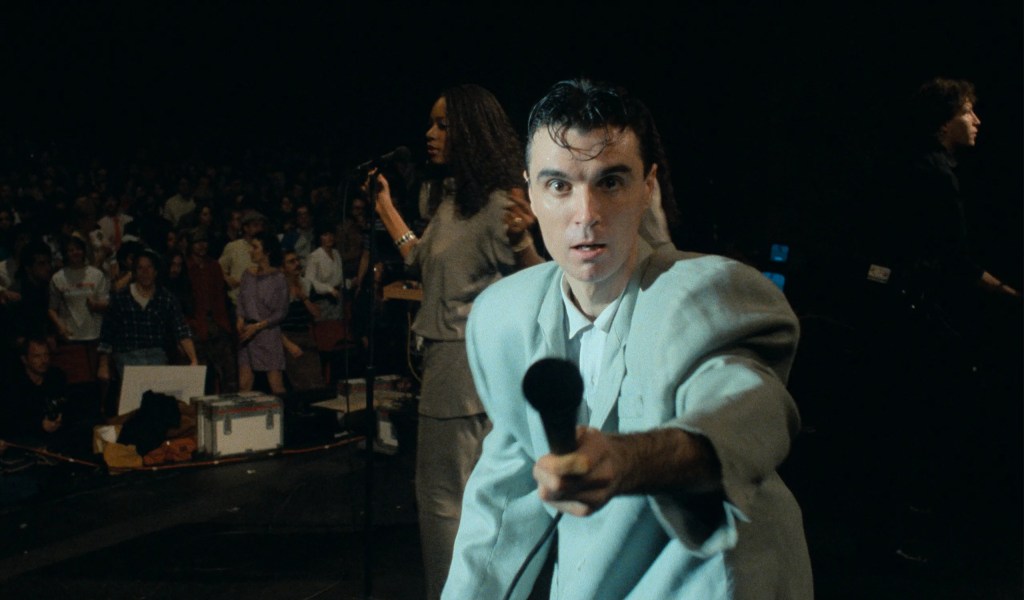
After this poppy interlude, Byrne comes back on stage for the most iconic part of the movie. When Byrne returns he is wearing an oversized suit. It can be seen on the album version’s cover, as well as the movie’s poster. They perform “Girlfriend Is Better” with Byrne in the massive suit, doing goofy dances to rival that of those done during “Life During Wartime”. This is perhaps the most rewarding part of the whole movie, as it is the memorable moment, and has everything anyone could need.
“Girlfriend Is Better” ranks amongst the band’s best, and for obvious reasons. It is dancy and accessible, a perfect 80s new wave tune. The lyrics are interesting and captivating. However, it is the big suit that is the main attractor here. It is truly awe-inspiring, and the best gesture of artistic choice made in the movie. It is one thing that makes this movie not just chock-full of amazing performances of some of the best songs of the 70s and 80s, but also the best concert film of all time.
The last two songs here are a fantastic way to end the show. Interestingly enough, it is the same two songs that end The Name of This Band, but in reverse order. “Take Me to the River” is an Al Green cover that is the penultimate song on More Songs, but this version is much more maximalist. It is also important because Byrne finally introduces the entirety of the band by name. The final song, “Crosseyed and Painless” hails from Remain In Light, and features many different sections (including a bridge made up of Byrne rapping) and components sewn together to create a masterpiece. It is the perfect way to end a larger masterpiece.
Byrne thanks the crew, and then the band leaves. The curtains come to a close. In less than an hour and a half Talking Heads have made the golden standard of what a concert movie should be. They have made the platonic ideal of a performance. Stop Making Sense demonstrates everything they were capable of at their peak.
It must also be noted that in anticipation of the theater re-release of the movie, they also issued a deluxe version of the album featuring two songs not featured in the movie, including a version of personal favorite “Cities” with different lyrics.
Stop Making Sense is a must-watch for any Talking Heads fan, no matter how casual. It demands to be seen. If you can see it in theaters, you simply must. Seeing it in theaters was an incredible treat, I can’t recommend it enough.




 ACRN.COM
Leave a comment