[Graphic courtesy of Julia Weber]
By the ACRN editorial team
Each year, ACRN’s editorial team gets together to discuss the best and worst moments in culture. This year, our film writers selected a handful of their favorite releases of 2024 and wrote about what they loved most and why.
10. The Substance — Coralie Fargeat [Working Title]
I’ve written about this earlier this year, and was rather high on it. It’s since lowered, but has never lost its importance in this year. Repeat viewing won’t do this movie any favors, partially because the movie can never be as impactful after first viewing, and that’s by design. But as it stands, it’s the premiere horror film of the year. The disgusting nature of the presentation separates itself, comically advancing until there’s nowhere else for the movie to go, or so you think. The twists and turns make the first viewing truly special. It takes place in a lifted reality from an auteur that knows how to construct a horror picture. Coralie Fargeat puts a good deal of effort into making this special, although the inability for repeated viewings may make history view this more harshly than it deserves.
— Cody Englander, Copy Editor
9. Evil Does Not Exist — Ryūsuke Hamaguchi [NEOPA]
A personal favorite, this is one I recommend to everyone who has a chance to see it. The only foreign language movie on this list, Ryūsuke Hamaguchi’s masterful work is a low-stakes town drama. A tourist site may come to this small town, offering economic flourishing but shifting the natural beauty of the town. It’s a movie that’s lonely, a movie that longs for a life that isn’t there. It slowly burns itself into the watcher, bringing them into this town. The boardroom meetings are as entrancing as most action scenes. Every shot is as beautiful as the town itself. The score and the performances all culminate in achieving a feeling – it’s about the story as much as it works to make the audience want to feel, emotion being an aspect of filmmaking that Hamaguchi has come to master throughout the years.
— Cody Englander, Copy Editor
8. Kneecap — Rich Peppiatt [Fine Point / Mother Tongues]
Rich Peppiatt’s film about a trio of Irish rappers who rap in their native tongue is a fun and hopeful piece of cinematic autofiction. The film stars the band Kneecap as themselves and recounts their origin story. The film also stars Michael Fassbender and Josie Walker in supporting roles. The members of the band are all surprisingly great actors, with DJ Próvaí or J.J. Ó Dochartaigh, giving an especially exceptional performance.
The band has been somewhat elusive about which aspects of the film are fictional and which aren’t. This blending of the truth with fiction helps to emphasize that the film is about more than just the story of Kneecap’s formation. The film focuses on the lasting impacts of British colonization on Ireland and how it impacts the personal lives and relationships of those living in Belfast and beyond.
Ultimately, Kneecap is both a feel-good film and a call to action. The ending title card states that globally, “an indigenous language dies every 40 days,” making clear that the film is showcasing what actually inspired the formation of Kneecap, which is the preservation and platforming of the Irish language.
Kneecap uses its interesting and novel premise to delve into larger political ideas. Is it wholly original? Are these guys actually good rappers? I’ll let you decide, but with a film this unique, fun and heartfelt, it is hard for these questions to dampen the experience of watching it.
— Kate Wiselogel, Contributor
7. Dune: Part Two — Denis Villeneuve [Legendary]
Every once in a while, a science fiction story engraves itself into the pantheon of pop culture history. It’s a rare occurrence, but it happens when the stars align, as they did for Dune: Part Two. The cast is a “who’s who” of stars, with Timothée Chalamet front and center. This film uses the camera and scale in ways science fiction predecessors don’t, marking a fundamental change in the genre. The score is one of the main takeaways for a lot of the audience, keeping the Hans Zimmer score on repeat long after the theater experience. Dune: Part Two leans into its epic roots: lengthy while never being boring. That’s due in large part to Denis Villeneuve’s creative direction. Like Zimmer, Villeneuve conducts the camera almost like an orchestra. There’s not a bad shot or a missed note in the entire 167-minute runtime. As much as Arrakis is a hellbound world, the audience can’t help but want to stay there as long as possible.
— Cody Englander, Copy Editor
6. A Different Man — Aaron Schimberg [A24]
A24’s psychological thriller-comedy, A Different Man, directed by Aaron Schimberg and starring Sebastian Stan, is one of the smartest and most clever films to come out this year.
A Different Man features Stan giving a career-best performance as an aspiring actor who undergoes an experimental treatment to cure his facial disfigurement, only to lose out on his dream role and relationship because of his change. It is rare that roles this perfect come along and allow their actors to showcase as many conflicting emotions and depth as this one does for Stan. He plays the resentment, jealousy and insecurity of his character, Edward, wonderfully. Moreover, Adam Pearson, who plays the film’s confident and lovable antagonist, Oswald, also gives a great performance.
A Different Man relies heavily on its well-written screenplay. At times, it even feels a bit like a play due to how many of its scenes take place in the same small, confined spaces. The way the plot of A Different Man unfolds is very fun to watch. It feels like a classic film festival movie/Oscar contender. There’s a timeless quality to it and it is highly rewatchable.
Despite starring several established actors, the film feels like the start of something new for both Stan and Pearson and it will be exciting to see what projects they each do in the future.
— Kate Wiselogel, Contributor
5. Trap — M. Night Shyamalan [Blinding Edge]
M. Night is one of one. His catalog is complicated, but he’s always been a passionate filmmaker and takes chances other directors wouldn’t dare to. Trap is a Hitman mission with a heart. There’s a lot special about this, notably the cinematographer, Sayombhu Mukdeeprom. The construction of images throughout the movie is special. It’s the camera as a piece of an orchestra, conducting Josh Harnett’s every move. The missteps of the camera are the missteps of Harnett’s character. It’s a low budget blockbuster that doesn’t ask too much from the audience, but offers a very fun experience. It’s one of Shyamalan’s best, and triumphs in a year where many blockbusters falter.
— Cody Englander, Copy Editor
4. Conclave — Edward Berger [Focus Features]
Edward Berger’s drama about the highly secretive, stressful and petty process of choosing a new pope features a star-studded cast and a great screenplay. Ralph Fiennes plays the lead role, the head of the titular conclave, while John Lithgow, Isabella Rossellini and Stanley Tucci have supporting roles. The film simultaneously conveys the heightened stress and the absurdity of the situation. At its best, the film feels like a version of Mean Girls (2004) that centers on a bunch of aging cardinals, with the various candidates for pope attempting to take the others out of the running. As the film unravels, so do philosophical debates about how the catholic church should be run and by who. Conclave feels very much like a classic awards season movie, it’s political, it features an ensemble of established stars and it provides the space for its ensemble to give really great performances.
— Kate Wiselogel, Contributor
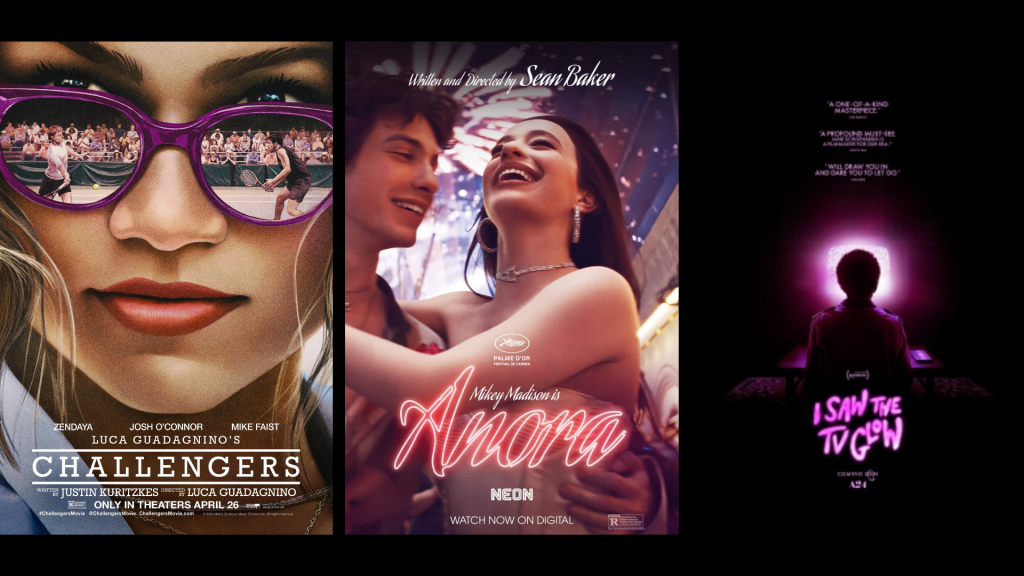
3. I Saw the Tv Glow — Jane Schoebrun [Fruit Tree]
Jane Schoebrun’s sophomore feature is a coming-of-age horror film. It follows Owen (Justice Smith), a shy young boy who becomes obsessed with a Buffy the Vampire Slayer-esque TV show, “The Pink Opaque,” after being introduced to it by his friend Maddy (Brigette Lundy-Paine). The film is largely an allegorical view of transgender identity and the terror that comes with self-expression.
I Saw the TV Glow is an ambitious and unapologetic film. It hammers its point home without necessarily holding the viewer’s hand. The sheer scale of what Schoebrun does in this film is admirable in and of itself. Smith’s performance is heartbreaking and real. It is the kind of movie that doesn’t leave you for months after you’ve watched it.
Music fans will be interested to know that Snail Mail’s Lindsay Jordan has a supporting role in the film as one of the stars of “The Pink Opaque”. The film also has an extraordinary soundtrack featuring original songs such as “Starburned and Unkissed” by Caroline Polachek and “Claw Machine” by Sloppy Jane featuring Phoebe Bridgers. The saturated high school sequence that features Polachek’s song is one of my personal favorite scenes of the year.
I Saw the TV Glow is a story of obsession, uncertainty and disembodiment in suburbia. While a hard watch at times, I Saw the TV Glow is incredibly original and an achievement in filmmaking.
— Kate Wiselogel, Contributor
2. Anora — Sean Baker [FilmNation]
Sean Baker has been receiving universal praise for his latest hit, and I can’t say it’s unwarranted. Anora may be the surprise comedy of the year. The structure offers a unique direction, and is something that Baker hasn’t really done before. Praise for this movie shouldn’t come without talking about how Mikey Madison’s breakout performance is incredible. She controls every scene without even trying, and has so many quotable lines. The script wouldn’t work without her giving 110% every step of the way. It’s three movies all put into one, but I don’t think any of them would work on their own. The fairytale, the fall, and the pieces of it all. It’s Baker coming into his more commercialized form, transforming his storytelling through a bigger budget, while not losing the charm of his earlier work. It’s one to keep an eye on for awards season, and for good reason.
— Cody Englander, Copy Editor
1. Challengers [Metro-Goldwyn-Mayer]
Luca Guadagnino’s film about a love triangle between three professional tennis players over the course of 13 years is the most exciting film to come out this year and a fascinating meditation on love, attraction and power.
The film’s leads, Zendaya, Mike Faist and Josh O’Connor, all give incredible performances that complement one another. Challengers could’ve easily been corny if even one of its three leads had not been at the top of their game. Instead, each gives their own complex and layered performance. The key to the film lies in Tashi Duncan’s (Zendaya) assertion that “tennis is a relationship.” The rest of the film sees its leads navigating their complicated relationships with each other through the game of tennis.
It isn’t just the charisma and talent of its leads that makes Challengers worth watching. Luca Guadagnino has shown throughout his career that he is brilliant at capturing the feelings of love and attraction, and Challengers, the story of “a love triangle where all corners touch,” is no exception. The technical aspects of the film are rendered perfectly. Its screenplay is sharp and emotional without ever feeling trite. Trent Reznor and Atticus Ross’ score is distinct and works to heighten the film’s emotional beats beautifully.
By the time Guadagnino starts having fun with shots that are from the perspective of the tennis ball whizzing in between players or from underneath the court, it is hard to think of Challengers as anything other than the best movie of the year.
— Kate Wiselogel, Contributor


 ACRN.COM
Leave a comment