By Isabella Ardetto, Contributor
[Focus Features; 2024]
Rating: 9/10
Yet another film has been dug up from its grave (in this case, maybe coffin is a better term) to be made anew.
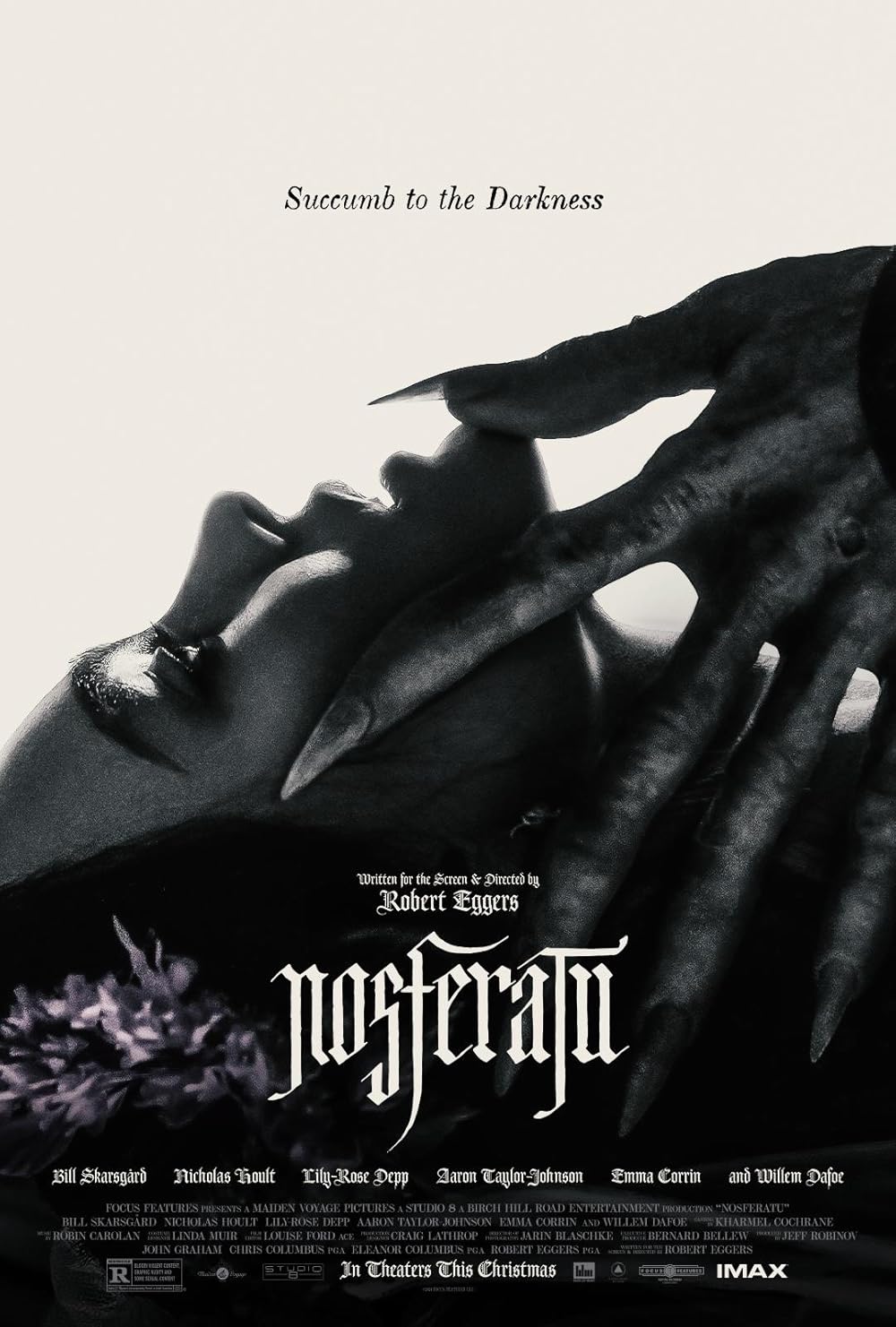
With the steady rise and seemingly unshakeable popularity in remakes (I’m looking at you, Disney), Robert Eggers does an exceptional job at breathing new life into one of horror’s most influential figures in his newest film, Nosferatu. Fans of Eggers will be once again swept up in all things dark, dreary and yet strangely alluring — qualities of which were present in his notable past creations (The Witch, The Lighthouse, The Northman).
Read more: Movie Review: Anora
Egger’s film follows in the footsteps of its century-old predecessor, F.W. Murnau’s haunting 1922 film, Nosferatu: A Symphony of Horror. Or, if you have similar attitudes as Florence Balcombe, Bram Stoker’s widow, the rip-off of the author’s novel, Dracula. Both stories have their similarities, but in this case, Egger’s uses Murnau’s cast of characters.
The movie follows Thomas Hutter (Nicholas Hoult), an aspiring and newlywed real estate agent who travels to Transylvania to sell property to a withered and monstrous Count Orlok (Bill Skarsgård) with the promise of a promotion. This journey takes him away from his beloved Ellen (Lily-Rose Depp) who pleads with him to stay with her as an old, forgotten doom begins to make itself known. This impeding plague is none other than Orlock who seeks to steal away Ellen to satiate his morbid hunger.
Something that stuck out to me in particular while watching this film was the cinematography. Specifically, Egger’s masterful use of color. Though I often criticize, and even lament, on how dull modern movies look, Nosferatu is a rare case in which the monochromatic palette puts the audience exactly where Egger’s wants them to be. This movie is devoid of life, purposefully making sure the audience comes face to face with the darkness that pervades through the entire movie. It is also more notably a homage to its predecessor’s black-and-white picture. Even with glimpses of color throughout the movie, they are inevitably snuffed out and cast in darkness the next moment to remind us there is a seemingly unshakeable evil at large.
Egger’s rendition of Nosferatu was made truly unique by Bill Skarsgård in my opinion. Skarsgård is nearly unrecognizable in his role, transforming into the grotesquely captivating Count Orlock with the help of an impressive 62-piece prosthetic and distinctive Transylvanian accent. His presence in the movie is hauntingly suffocating — he seems to fill an entire room with his dominating stature that makes Orlock stick out uncomfortably even as he blends into the shadows that are always around him, part of him. And unlike Murnau’s silent film, Skarsgård’s resonating and omnipresent Count voice demands attention to each word, leaving the audience awaiting each word after rattling, laborious breaths.
And I would be remiss to not also mention Lily-Rose Depp’s stirring performance as well. Unhinged and yet masterfully reserved when needed, Depp portrays elements of repressed desires, sexuality and facing the darkness within us. Her performance is reminiscent of Isabelle Adjani in Possession, vulnerable and raw as much as it is disturbing. Contorting and seizing up, Ellen’s struggle against an ancient evil becomes unsettlingly real and unavoidable to audiences as they watch Depp writhe in agony and, at times, pleasure. Yet in other moments she is hypotonic and wistful, truly captivating even in brief moments of calm.
Nosferatu is a testament that remakes need not be the same old story with new and popular celebrities thrown in just to make audiences go see it. Egger’s, the cast and the crew all came together to create something new for audiences to sink their teeth into for generations to come, making Nosferatu a must watch.




 ACRN.COM
Leave a comment