
[Photo courtesy of Megan Young]
By Julia Weber, Editorial Director
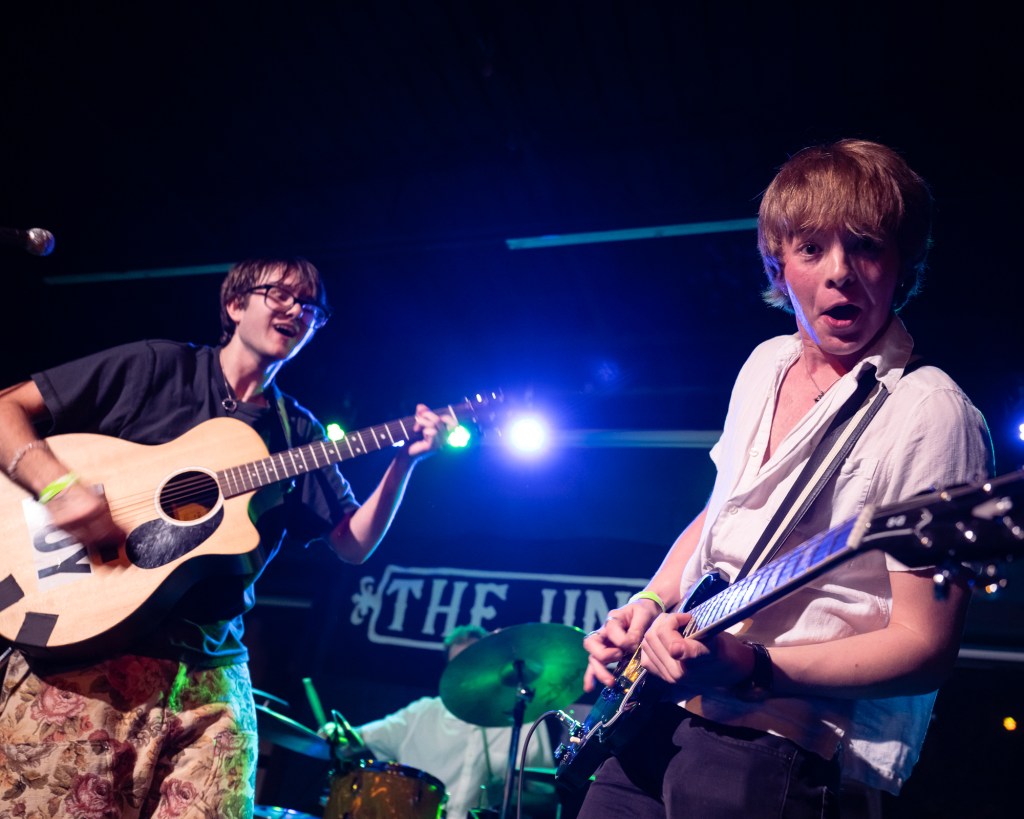
This year’s Lobsterfest was packed with emerging artists from all over North America, including Dazy, a Virginia-based guitar project deemed a “Band to Watch” by Stereogum in 2022. Ahead of his Saturday headlining set of Lobsterfest 2025, I spoke with Dazy’s James Goodson about his writing and recording process, where he finds inspiration and his favorite part of playing live shows.
[This interview has been edited for length and clarity.]
JW: Have you ever been to Athens before?
JG: No, I haven’t. I feel like I’ve been to a good amount of Ohio, but never Athens. Maybe I’ve passed through, but I definitely have never played a show there.
JW: It’s kind of a hidden gem, but it’s a good place to be.
JG: I’ve heard that it’s a hidden gem, actually, from multiple people, so that must be real.
JW: You’re set to play Lobsterfest this coming weekend, which is super exciting. You’ve been releasing some EPs recently, a lot of singles and some remixes as well as an album a year from 2021 to 2023. It seems that you generate music really quickly. Tell me a little bit about that.
JG: I like to stay busy. I like to stay writing songs. I’m always writing and usually, it’s more of a question of what kind of release I feel like doing more than like, ‘Are there enough songs?’ I always have enough songs. It’s really a matter of which ones I want to pick and where I want them to go. I tend to really like smaller, shorter releases. I really love EPs; EPs are maybe my favorite format. Sometimes I struggle with that because I don’t know if people are like, ‘Call me when it’s a full length’ but I really like shorter releases. I feel like there’s a sort of freedom to them where you can really try things, you can stretch out in different directions, but it still feels like a body of work. It doesn’t just feel like it’s a completely random thing, you can still make it have its own little cohesive identity, but it’s quick.
JW: It seems like it’s a lot of fun to toy with that balance of generating work really quickly and not overthinking it, while still putting the due effort into it of doing the tinkering and playing around with things and having that EP format to experiment, but also create something cohesive.
JG: I think some of the way that I write and put out music is almost actively trying to work against some of my own mental tendencies. I have a real tinkering habit and will really struggle to call something done. I think that doing shorter releases and trying to actively set up this quicker turnaround and have it be that way in my head helps me to push through that endless tinkering barrier a little bit. I always know (that) you put I like to track the progression of my music very actively. I like that if you listen to the very first thing I did and the next thing, next thing, next thing, you would hear this incremental trajectory to where it is now. It’s not these crazy, enormous ‘Woah, he went off in some insane direction over here,’ but if you listen to the first thing and then you skip ahead all the way to the most recent thing, you would be like, ‘Wow, a lot has developed.’
JW: Tell me about the writing and recording process. Is it usually music before lyrics or lyrics before music, or both at once?
JG: It’s almost always music before lyrics. It’s one of two things nowadays where either I’m holding a guitar and I’m strumming around and I start to hum a melody and throw it on a voice memo and then start demoing it and it goes from there, or a lot of my newer stuff comes from, I’ll be messing around with making a beat or something or a bass line and build it up from there. A lot of the newer stuff really starts drums first, actually. It’s also much more sample oriented, beat oriented, so a lot of it is starting with a really crazy beat that I liked a lot and then seeing where that leads. That’s been a fun, different way to write songs than just always starting with the guitar progression.
JW: You said that you always have plenty of songs to pull from, and it’s just a matter of which ones you want to put out. What’s next on the horizon?
JG: I don’t totally know. That’s kind of the big question right now. I kind of want to play it slightly close to the chest, but I have some ideas that are maybe not quite an EP but not an LP. I want to try some things that are maybe a little different. I’ve also always wanted to do another collection record. I collected all my early singles onto one thing, and I’ve always wanted to do that, so I wouldn’t be surprised if I land on that eventually with a lot of these new, smaller releases. I said earlier that I wasn’t quite wanting to do an LP yet, but it’s cooking adjacent to all this other stuff. I have a sense of what songs might end up on the next LP and what that direction is going to be and everything, so it is definitely leading to LP two, it’s just a matter of how many stops I want to make along the way.
JW: Another thing I’ve noticed through listening to your music is that it really seems like collaboration is a very integral part of your creative process and what you’re putting out. Tell me about the component of collaboration and working with others in your music.
JG: When I first started doing the Dazy stuff, it was very intentionally real control freak s—. It was like, ‘I’m recording everything, I’m playing everything, I’m writing everything, I’m doing all the art.’ The only other person involved was Justin Pizzoferrato mixing everything, but even that, that’s sort of my main point. Even early, early on where it was like, ‘This is going to be as direct from my brain to anyone’s ears as possible,’ I still had another person that I had in the mix bouncing ideas off of, or at least bouncing mix ideas and things like that around with and helping to guide certain things. When I was doing it really early on like that and was holding so tightly to everything, I think a lot of that was based on coming out of previous bands and stuff like that. Everything you do is a reaction to the previous thing you did, and now, I’ve put out like 50 songs or something like that, so I’ve done the ‘I made it all super close to just my brain’ thing quite a bit, so I think that’s why it’s been really fun to start doing more stuff like, obviously, I work with Ian from Militarie Gun on a lot of things. We’re always cooking up stuff.
JW: It’s interesting to hear that evolution. I was reading your Stereogum feature last night, and I was reading about how you came from this space of being in bands and, of course, you transitioned to this insular practice, and now you’re opening that back up. It’s interesting to hear that timeline of the return to form and the fluctuation of collaboration throughout your discography.
JG: One thing that I’ve really been trying to do more with Dazy is, like I was just saying, opening myself up to trying different things and coloring outside the lines a little bit more. Early on, I had a really stringent idea of what I wanted everything to sound like, and I really love doing that and that’s a practice that I really enjoy where you set some boundaries for yourself sonically and see how far you can take that, and I felt like I really loved doing that and made a lot of songs within that space I set for myself. Through collaborating with other people and where my taste was going, I started wanting to expand those prerequisites a little bit, and (I) have found that to be really fun and to push myself in different ways while still trying to keep this spontaneous bedroom punk-y attitude of the whole thing. I’ve been starting to learn that early on, I thought the thing that defines this is that there’s a hundred guitar tracks on everything and they’re all making crazy feedback and it’s extremely noisy. It wasn’t until more recently where people were like, ‘You can make it sound however you want. The thing that defines it is that you wrote the song and are singing on it.’ It helped me to understand that the things that I was being a zealot about were not the things that actually defined the project the way that I thought. It’s been really fun and freeing.
JW: What’s your favorite part of playing live?
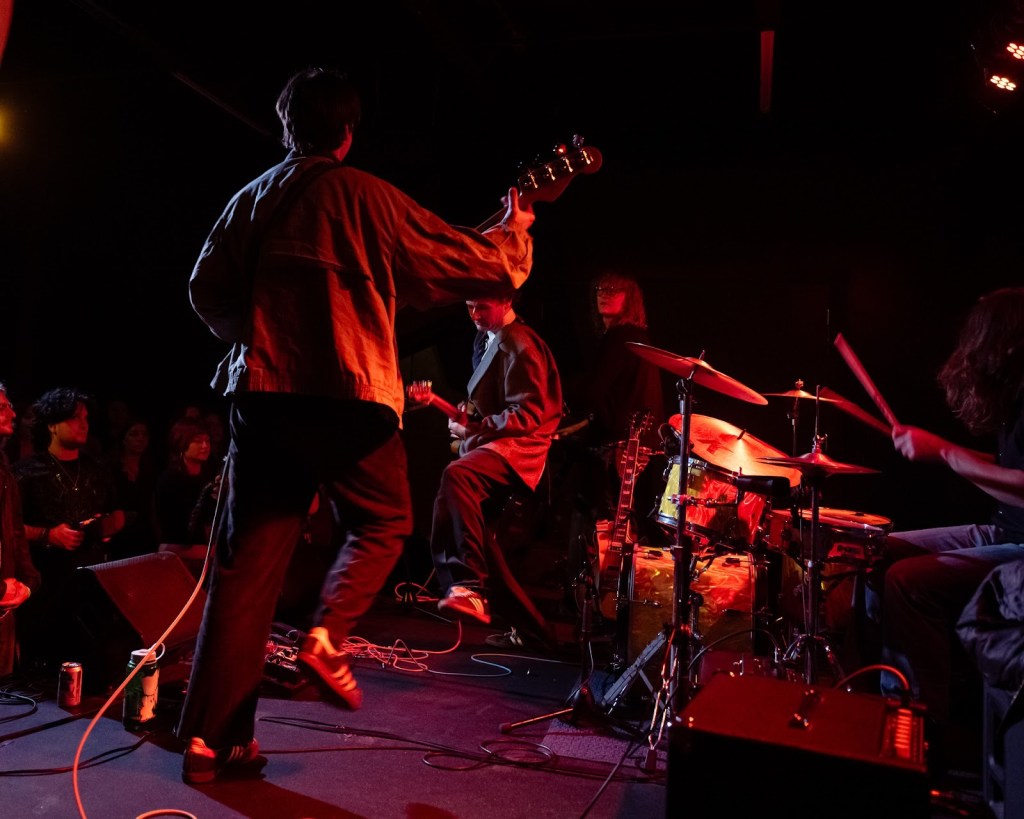
JG: As cliche as it sounds, the whole thing with playing live is when you see it connecting with people — especially with what you’re talking about of a lot of time, you play to people who maybe they’re not there to see your band, or maybe they’re there to hang out at a cool place or something like that — that feeling of winning an audience over, especially when you’re doing something like playing guitar music, rock music, alone on stage, it’s really satisfying to win the crowd over, to feel like you’ve successfully gone over anyone’s potential expectations and won them over to what you’re doing. Seeing people physically react to music, whether that’s just nodding their heads or jumping around or whatever, it’s like seeing people have that uncontrollable physical reaction to like, ‘Ooh, I’m hearing loud music and a good beat, and it’s catchy and I’m having a good time. My head can’t help but bop.’ That’s just the best thing.
JW: For being on the spot, that’s a great answer.
JG: [Laughter] I mean it from the bottom of my heart. That’s how you know that that was a real answer; no one has ever asked me that before.
JW: Outside of music, what are you inspired by?
JG: I really love movies. There are times where I see something in a movie, whether it’s something that somebody says or even just a visual element, sometimes it really sticks with me, and it’s not necessarily that I’ll go into something being like, ‘Ooh, I gotta write a song about this movie,’ but it’s more like there’s a tone or something, or an idea that I really like and maybe that helps me come up with a lyric idea. I definitely think of my music a lot in the context of ‘What would this be like in a movie?’ A lot of people tell me that my music sounds like the kind of thing that would have been in soundtracks to 90s movies and early 2000s movies, and honestly, that’s one of my favorite things to hear because that’s definitely what I’m going for. I grew up on having these soundtracks to movies like A Life Less Ordinary and even early Quentin Tarantino movies and stuff like that. Stuff where you would learn a lot about music from the soundtracks, and that definitely is a thing that I try to do with music is think of it as ‘What if these movie soundtracks were all one band?’ That’s definitely a thing that impacts the way I make music, and other than that, the thing that obviously inspires my music the most outside of music itself is my daily life and the people around me and my actual experiences. Most of my songs are autobiographical in some way, or at least about myself or people in my life. I’ve never really been able to crack the code on the more narrative ‘I’m writing about a completely made up thing.’ I’ve always wanted to figure that out, but it’s never been my forte so far.
JW: What’s your favorite song right now?
JG: Let’s look at my streaming service here and see what I’ve got. I actually have a great answer for this. So, there’s this band called J. McFarlane’s Reality Guest and they did a record a few years ago that was a little more guitar-y. They put out a record last year that is pretty trip-hop oriented and I really love it; it was one of my favorite records of last year. On this tour, I’ve been listening to it a ton while driving, and there’s this song on it called “Caviar” that I’ve been putting on repeat when I’m driving at night. It’s a really cool, mellow trip-hoppy song and when you’re driving alone at 1 a.m., it’s the perfect song to listen to.


 ACRN.COM
Leave a comment